

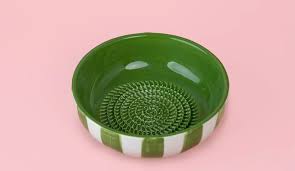
Spanish tapas in my kitchen
The Grating Plate – A Small Item with a Big History
Some kitchen tools come and go. Fads. Trends. One season everyone has them, the next they're forgotten.
And then there are those that simply endure.
The grating plate is exactly that.
I first saw it in Spain – in a small, simple kitchen. On the table: tomatoes, garlic, olive oil, and bread. And that plate with a rough bottom.
You take a tomato, rub it. Then garlic. Pour oil over it. A little salt.
And that's it.
And then you understand – why a blender?
Where did it come from?
In Spain, this plate is called a "plato rallador." It's a very simple, yet ingenious invention – a ceramic plate with a specially rough, serrated surface.
It has been used for a very long time. Especially in Catalonia and other Mediterranean regions, where cuisine is based on simplicity.
Where there's no desire to over-process, over-mix, "improve" everything.
Where the ingredient matters.
And one of the classics – pan con tomate.
Bread, grated tomato, olive oil, salt.
It all starts with that plate.
How to use it?
Very simply. And therein lies its beauty.
For tomatoes
– cut in half and grate directly onto the plate
– you get a puree with all the texture
For garlic
– a few rubs and it's almost a cream
For ginger
– perfect, especially when you need it finely grated
For hard cheese
– smaller quantities, when you don't want to pull out a large grater
Even for chocolate or lemon zest.
And most importantly – everything happens right there. On the same plate. No extra dishes, no mess.
For me, it's one of those things that saves not only time but also energy.
How does it fit in today?
We live in times when cooking is often overcomplicated.
Too many gadgets. Too many steps. Too much noise.
And then an item like the grating plate appears.
Quiet. Simple. Beautiful.
It brings you back to a very clear relationship with food.
You see what you're doing. You feel the texture. The smell.
And suddenly, cooking becomes not a process, but an action with meaning.
I think that's why it "fits" so well into modern kitchens.
Because we're all a bit tired of excess.
And we want things simpler.
Is it just a tool?
No.
To me, the grating plate is also a kitchen detail.
A beautiful piece of ceramic that can stand on the countertop. That doesn't need to be hidden in a drawer.
Minimalist. But with character.
Very suitable for a modern kitchen where everything is carefully considered.
Where you want to have less, but better.
And it's also very "giftable."
The kind of item a person might not understand at first, but then starts using and thinks: how did I live without it?
If I had to give one argument
I always say – good kitchen items should be used often.
If it sits in a drawer – it means it's unnecessary.
The grating plate is one of those you start using daily.
In the morning – garlic for a spread.
At lunch – for tomatoes.
In the evening – for ginger or lemon zest.
And it's always at hand.
And perhaps that's the whole essence.
Not technology.
Not complexity.
But a simple, beautiful way to cook.

Leave a comment
This site is protected by hCaptcha and the hCaptcha Privacy Policy and Terms of Service apply.